

World Cup "Sleepover"
First time foreign visitors are overwhelmed by America's charm, graciousness and abundance

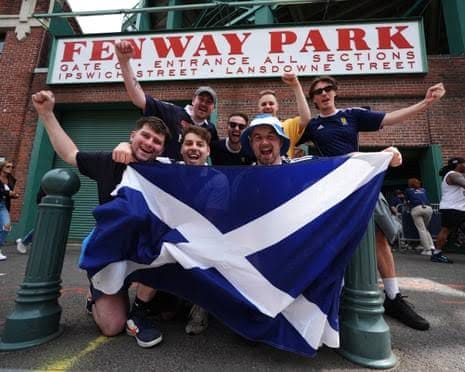
Hey, the 2026 FIFA World Cup is going on. You know. Fútbol. “The beautiful game” (or o jogo bonito in Portuguese). It is, far and away, the world’s most popular sport. A record 1.5 billion people watched the 2022 finals; the entire 2022 tournament engaged around 5 billion people across all platforms. And it’s going on right here in North America — specifically, the United States, Canada and Mexico — with matches played at 16 venues. Eighty percent of the matches will be played in the U.S. in the month-long tournament.
That means a whole lot of eyeballs are focused on us (nee: the U.S.)
Tens of thousands of Europeans and other world fútbol pilgrims descended on the U.S. in early June, fearing the America of their fever dreams: loud, rude, uneducated, uncultured, uncouth, sometimes violent slobberknockers waddling between gun stores and drive-thru windows, all the while screaming and beating their chests: “Murica!”
What they actually found was something slightly weirder and far more delightful. They found a nation where everyday life feels as if it were designed by a committee of smiling, highly caffeinated optimists with funny accents who never heard the word “enough.” Foreign visitors are surprised, amazed really, by the hospitality, friendliness, food, scale, and our everyday conveniences, and have expressed it in hundreds of thousands of social media posts (TikTok, Instagram, YouTube, “X,” etc.).
But they are equally awed by our genuine superpower: Freedom.
They feel that they’ve been lied to about America, about our culture, our character, our energy, our spirit … our je ne sais quoi.
We are grateful for the compliment.
Meet Freddy
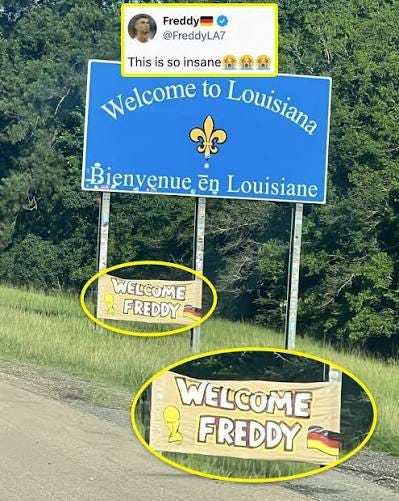
If you want to know where this whole thing started, we can blame no one other than Freddy. He’s a German dude who had 11,000 followers on his X account, simply posting about his trip across the country starting in early June.
He came to America and expressed appreciation for everyday stuff in a way that felt authentic to Americans. He was in awe of the vastness and beauty of the countryside and thankful for the diversity and hospitality of our citizens.
And Waffle House. He loves Waffle House. Go figure.
If there’s anything Americans appreciate, it’s authenticity. Freddy caught fire. He went viral. He became an instant celebrity, having passed 700,000 followers in less than a week. Freddy is ground zero for World Cup mania because America saw one earnest German and completely lost its mind.
Signs went up on state lines. States bought billboards. Ex-football star JJ Watt put him up in a hotel. The Houston police fed him barbecue. The mayor met him at an Astros game. NASA gave him a private tour, walked him into the Orion capsule that just flew around the moon, and called the International Space Station to talk to the German astronaut.

He mentioned that recording star Ella Langley was playing all the time on the radio, and that it became the soundtrack to their road trips. So, naturally, he got tickets, swag, and a meet-and-greet with Langley. And when his flight to Canada to see his beloved German National Team got cancelled, it set off a bidding war among two airlines, a private jet company, JJ Watt, and the governor of Utah, to fly him to the match.
Now, he’s been invited to the White House to meet you-know-who.
We in America adopted this lovely man. One European was nice about us, and we responded by offering him the moon.
Literally.
Scale and abundance
Buc-ee’s (The Petrol Station Beaver)
The most immediate shock about America comes from scale and abundance, the latter of which is a political campaign trope in 2026. Europeans often come from denser countries with smaller stores, tighter retail regulations, and modest portions. In the U.S., they encounter hyper-sized supermarkets, outdoor retailers (think Bass Pro Shops), and gas (petrol) stations.
Take the gas station. In Europe, a petrol station is where you grimly refuel your sensible hatchback, grab a meager sandwich wrapped in plastic, and pray the bathroom doesn’t require a hazmat suit.
In America, especially in Texas, where everything is big, there are Buc-ee’s.
Germans and Brits have posted videos of themselves wandering these colossal temples of convenience commerce like they’ve discovered Atlantis with a beaver mascot. One British tourist filmed himself inside one and captioned it “THIS IS A PETROL STATION???” He realized his entire continent has been gaslighting him about what convenience actually means.
(double click twice to watch a 16-minute video on the World Cup sleepover)
Buc-ee’s has clean bathrooms, brisket sandwiches the size of small school buses and enough snacks to feed a small army — actually a large army, for a year. One Swedish customer marveled in an Instagram post that Buc-ee’s has an 80-foot wall of jerky, their own brand — chicken, beef, pork — in every conceivable flavor, as far as his eye could see.
In America, especially in Texas, where everything is big, there are Buc-ee’s. Germans and Brits have posted videos of themselves wandering these temples of convenience commerce like they’ve discovered Atlantis with beaver mascots. One British tourist filmed himself inside one and captioned it “THIS IS A PETROL STATION???”
Meanwhile, Americans treat it like Tuesday. The rest of the world is still recovering from the revelation that a place selling gasoline can also function as a theme park, buffet, and gift shop without anyone dying of shame.
Costco and Walmart
Supermarkets are where the scale really hits home. European grocery stores are compact, efficient, and designed so you don’t accidentally wander into another time zone while looking for milk. America has Costco and Walmart, with aisles so long you need a GPS and a snack for the journey. Europeans filmed themselves in the cereal aisle — both sides — with a dozen varieties of Fruit Loops. One Euro snickered that the bagged cereals were the size of his torso.
“There are thirty-seven kinds of the same thing. Why?” Because choice, apparently. And because someone decided that if you’re going to sell breakfast cereal, you might as well sell it in every size, flavor and shape imaginable.
A Norwegian held up a 20-pound package of ground beef the size of his arm. A curious Swede grappled with a gigantic jar of pickles. An Italian (they’re not even in the World Cup) hoisted up a gallon of milk — he couldn’t help but laugh.
Only at Walmart and Costco can you cart out a 84-high defenition TV, three polo shirts and a dozen croissants.
And a $5 roast chicken.
Refill and food portions
Then there’s the free refills. This one broke France. In Paris, ordering a second Coke is treated like a request for a kidney transplant — possible in theory, but you’ll need forms, a specialist, and possibly a papal dispensation. Americans just keep pouring. You finish your drink, and the server appears like a soda genie: “Another?” Europeans stare in awe.
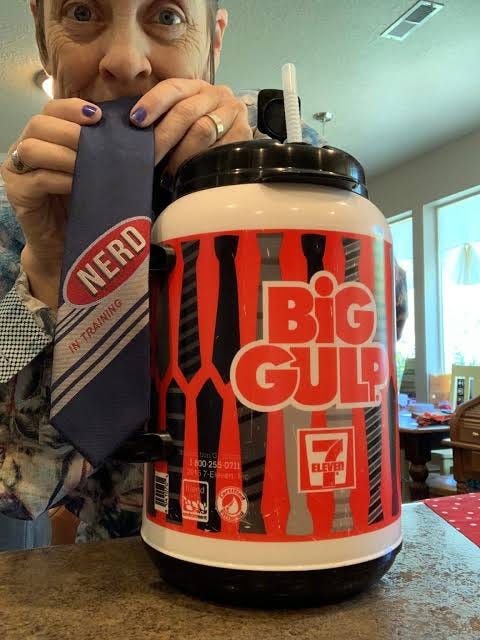
A Croatian fan filmed himself at a restaurant and kept hitting the button on the self-serve machine until security gently suggested he might be testing the limits of capitalism. The concept that a restaurant might want you to drink so much sugar you vibrate through the floorboards is revolutionary. They came for the beautiful game and left wondering why their governments ever told them unlimited beverages were a public health crisis.
Food portions are another category of delightful free market terrorism. American plates arrive looking like someone lost a bet with a forklift. Europeans order “a burger” and receive what appears to be a small planet between two buns, plus enough fries to build a barricade. They take photos of ranch dressing like it’s a rare gem.
Air Conditioning and showers
Europeans sweat politely through summers and consider ceiling fans a bold technological advance. Especially now, in France, where 40 people have drowned in unauthorized swimming holes due to the scorching heat. Americans walk into buildings that feel like the inside of a refrigerator and immediately relax as if they’ve been granted parole.
The fact that every hotel, restaurant, and stadium is aggressively climate-controlled is apparently life-changing when you’re used to opening windows and hoping for the best. Shower heads more resemble a fire hose than a trickle of tepid water.
What they’re really amazed by is how unapologetically “extra” America is. Europe often operates under the quiet assumption that life should be reasonable, regulated, and heavily restrained.
America smiles … a lot
Scots have been live-tweeting their first encounters like war correspondents: “The lady just called me ‘hon’ and brought me waffles the size of my head. I think I live here now.”
The friendliness is perhaps the most suspicious part. Strangers hold doors. Cashiers say “have a nice day” like they mean it. People smile in public without an obvious scam attached. One German fan documented Americans holding doors for him and looked genuinely concerned, as if he’d unexpectedly joined a cult. “They just… open the door? For free? What do they want?”

Nothing. That’s the terrifying part.
In much of Europe, public politeness has been optimized down to the bare minimum required by law and social contract. In America, someone will hold your door, compliment your shirt, smile, and ask how your day is going while you’re still processing that the door was held in the first place.
It’s like discovering your entire continent has been running on low-power mode.
The Tartan Army
The Tartan Army’s invasion began the moment the first kilted Scotsmen touched down in Boston. Locals braced for soccer hooligans; instead, they got 40,000 men in skirts who treated Gillette Stadium like a family ceilidh.
One bewildered cop, drafted into a keepy-uppie contest, ended the night with a new kilt and three marriage proposals. Bars ran out of Sam Adams by Saturday lunchtime; by Sunday, the Scots had restocked them with Irn-Bru and single malt, then scrubbed the sidewalks.

A Boston city worker summed it up: “They drank the place dry, sang until the seagulls filed noise complaints, and left zero litter. It’s the politest invasion since the British left in 1776 — only louder.”
The Army then chartered south to Miami. Imagine: making a fashion statement with kilts and flip-flops. South Beach had never seen so many hairy knees in one humidity index. Bagpipes competed with reggaeton and lost, so the Scots simply sang louder.
A Boston city worker summed it up: “They drank the place dry, sang until the seagulls filed noise complaints, and left zero litter. It’s the politest invasion since the British left in 1776 — only louder.”
By night three, Hard Rock Stadium echoed with “Flower of Scotland” in Spanglish. Security tried to enforce “no bagpipes after 11 p.m.” until one particularly persuasive Tartan negotiated a ceasefire with free drams and a rousing chorus of “God Bless America.”
When the final whistle blew, the Tartan Army departed as they arrived: singing, slightly sunburned, and leaving both cities cleaner, happier, and convinced that the best way to conquer America is with bagpipes, charm, and absolutely no litter.
World Cup: Friendly vibes
America operates under the assumption that if something can be bigger, louder, friendlier, or more convenient, it probably should be — consequences and waistlines be damned. The World Cup visitors expected caricature and found a place where the gas station has better bathrooms than most European hotels and strangers treat you like family.
They came to watch football. They stayed because someone handed them a bottomless drink and held the door on the way out. And honestly? After years of being told America is a cautionary tale, discovering it’s mostly just aggressively hospitable and comically oversized feels like the funniest plot twist of the tournament.
###

Jim Geschke was inducted into the prestigious Marquis “Who’s Who” registry in 2021.
Even now, The Atlantic has written a story to help bring the narrative of America The Horrible back into vogue. This World Cup is turning out to be the accelerant that torched the captured media while illuminating independent journalism.